


Member Countries

ecocci
Iran lifts import ban on all goods listed under preferential trade agreement with Pakistan

TEHRAN – Iran’s Trade Promotion Organization (TPO) announced on Saturday that the imports of all commodities listed under an Iran-Pakistan preferential trade agreement have been allowed by the government.
In late November, the Iranian Industry, Mining and Trade Ministry had got the government’s approval for allowing the import of some products exclusively shipped from Pakistan under the framework of the preferential trade agreement between the two countries.
Now, Iranian importers have been allowed to register import application forms for all products that were previously on the Islamic Republic of Iran Customs Administration's (IRICA) import ban list, provided that the source of the commodities is Pakistan.
Tehran and Islamabad have been taking new measures for broadening economic ties as the Iranian government is promoting economic diplomacy in the region.
Back in October, Iran Chamber of Commerce, Industries, Mines and Agriculture (ICCIMA) and the Federation of Pakistan Chambers of Commerce and Industries (FPCCI) signed three memorandums of understanding (MOU) with the aim of expanding trade between the private sectors of the two countries.
The MOUs were signed during a visit of an Iranian private sector delegation headed by ICCIMA Head Gholam-Hossein Shafeie to the Pakistani cities of Karachi and Lahore.
Based on the signed memorandums, the two sides agreed to strengthen comprehensive cooperation between the private sectors of the two countries, to establish a joint trade council of Iran and Pakistan, and to determine a mechanism to resolve trade disputes.
During their visit to Pakistan, the Iranian delegates also attended a meeting with officials from the State Bank of Pakistan (the country’s central bank) in which the two sides discussed details of a barter trade mechanism between the two countries.
After the trip of the Iranian trade delegation to Pakistan, TPO and the Tehran Chamber of Commerce, Industries, Mines and Agriculture (TCCIMA) also signed an MOU to pursue and develop free trade with Pakistan.
Speaking at the signing ceremony, TPO Head Alireza Peyman-Pak mentioned Pakistan as one of TPO’s priority markets for enhancing the country's business plans and emphasized that establishing direct transit as well as creating a financial and banking mechanism between Karachi and Tehran are two key axes in the development of business relations with this country.
Also, TCCIMA Head Masoud Khansari, in his speech, underlined the TCCIMA plans and actions in recent years to develop the economic relations of Iranian companies with neighboring countries and expressed the chamber’s full readiness to cooperate with TPO in order to develop exports to Pakistan.
Iran private sector stresses barter trade with Pakistan

President of Iran Chamber of Commerce, Industries, Mines, and Agriculture (ICCIMA) Gholam Hossein Shafei on Saturday underlined the significance for both Iran and Pakistan to pay due attention to barter trade and transit cooperation.
Shafei made the remarks in a meeting with Pakistani Consul General to Mashhad Muhammad Sheryar Khan.
He said that Iranian and Pakistani economies are complementary to each other and there are significant potentials which can led to a hike in bilateral transactions.
Referring to the efforts made by the Iranian government to boost trade with Pakistan over the past two years, the Iran Chamber of Commerce president said that efforts have been on the agenda in regard to preferential tariff and then moving towards free trade.
He said that there are problems on the way of implementing these plans so that economic interactions are not yet satisfactory.
Shafei noted that the two countries have been recently working on barter trade schemes with Zahedan Chamber of Commerce pursuing the issues on behalf of Iran and Quetta Chamber of Commerce being in charge of the matter on the Pakistani side.
He also said that Iran and Pakistan face different problems in the area of transit and transportation.
Iranian truck drivers have serious problems for crossing into Pakistan, Shafei said, adding that the two countries also need to take steps to improve customs infrastructures.
The Pakistani side, for his part, said that both Iran and Pakistan have to pay due attention to enhancement of bilateral relations.
Sheryar Khan said that the Pakistani consulate general in Mashhad stands ready to pursue the affairs.
He said that he agreed with the Iran Chamber of Commerce president that there are problems on the way of transportation, noting that the Pakistani drivers also have difficulty receiving visa for travelling to Iran.
He stressed the need for expansion of economic ties with the focus on the capacities of the two neighbors.
Iran private sector stresses barter trade with Pakistan

Iran private sector stresses barter trade with Pakistan
President of Iran Chamber of Commerce, Industries, Mines, and Agriculture (ICCIMA) Gholam Hossein Shafei on Saturday underlined the significance for both Iran and Pakistan to pay due attention to barter trade and transit cooperation.
Shafei made the remarks in a meeting with Pakistani Consul General to Mashhad Muhammad Sheryar Khan.
He said that Iranian and Pakistani economies are complementary to each other and there are significant potentials which can led to a hike in bilateral transactions.
Referring to the efforts made by the Iranian government to boost trade with Pakistan over the past two years, the Iran Chamber of Commerce president said that efforts have been on the agenda in regard to preferential tariff and then moving towards free trade.
He said that there are problems on the way of implementing these plans so that economic interactions are not yet satisfactory.
Shafei noted that the two countries have been recently working on barter trade schemes with Zahedan Chamber of Commerce pursuing the issues on behalf of Iran and Quetta Chamber of Commerce being in charge of the matter on the Pakistani side.
He also said that Iran and Pakistan face different problems in the area of transit and transportation.
Iranian truck drivers have serious problems for crossing into Pakistan, Shafei said, adding that the two countries also need to take steps to improve customs infrastructures.
The Pakistani side, for his part, said that both Iran and Pakistan have to pay due attention to enhancement of bilateral relations.
Sheryar Khan said that the Pakistani consulate general in Mashhad stands ready to pursue the affairs.
He said that he agreed with the Iran Chamber of Commerce president that there are problems on the way of transportation, noting that the Pakistani drivers also have difficulty receiving visa for travelling to Iran.
He stressed the need for expansion of economic ties with the focus on the capacities of the two neighbors.
Iran private sector criticizes non-implementation of intra-regional ECO agreements

President of Iran Chamber of Commerce, Industries, Mines, and Agriculture (ICCIMA) Gholam Hossein Shafei on Tuesday expressed dissatisfaction with non-implementation of the already signed agreements for expansion of trade among Economic Cooperation Organization (ECO) member states.
Shafei made the remarks during a meeting in Tehran with Secretary General of the Economic Cooperation Organization (ECO) Khusrav Noziri.
Shafei, who also heads ECO Chamber of Commerce and Industry (ECO CCI), said that the ECO ten member countries’ trade with the world totals a roughly $930 billion while their intra-regional trade hardly reaches $70 billion.
He argued that intra-regional problems between ECO member countries are far more than their problems with other world countries, referring, for instance, to difficult requirements for receiving business visa in some member countries.
Shafei also touched upon the problems on the way of intra-regional transportation among ECO member states which he said are hindering transportation cooperation despite the existence of agreements in this regard.
The ECO secretary general, for his part, said that in an ECO ministerial meeting in Uzbekistan in January, a final draft of Tashkent statement will be finalized which he said is related to expansion of trade, transportation and other ways of cooperation in the bloc.
Noziri said that, as like as the Iran Chamber of Commerce president, he is not satisfied with the intra-regional trade among ECO member countries and believes that there are many potentials that have to be used.
He said that ECO has a 500 million people population which accounts for 6% of the world population while the bloc has an only 4% share of the global trade.
He added that the intra-regional trade of the ECO states accounts for as few as 7.2% of their total trade with the world.
Noziri referred to a 2003 ECO Trade Agreement (ECOTA), noting that some member states have not yet agreed with the most significant article of this agreement which is about reducing tariffs in trade with other member countries.
He noted that the ECO members have agreed to double intra-regional trade from a current 7-8 percent of their total trade with the world to 15 percent in 2025.
Each member country has to do its share in fulfilment of the goals of the organization, Noziri said.
Not all the 10 member countries have equal capacities and Iran is expected to play a more active role in the bloc as China is playing the role of the driving force of the Shanghai Cooperation Organization (SCO), he added.
Isfahan to host 8th ECO Minerals Experts Group Meeting

Iran’s central city of Isfahan is set to host the 8th ECO Minerals Experts Group Meeting during November 14-17, 2022, Mehr News Agency reported.
Experts from seven countries including Pakistan, Azerbaijan Republic, Kazakhstan, Uzbekistan, Kyrgyzstan, Tajikistan, and Iran are to participate in the event.
The meeting aims at exchanging viewpoints of experts and managers of ECO member states and sharing new ideas and perspectives as well as solving the problems of the current geological and mineral sectors.
Economic Cooperation Organization (ECO) is an intergovernmental regional organization encompassing countries from Europe, Caucasus and Central Asia, West Asia and South Asia with more than 460 million inhabitants and over 8 million square kilometers connecting Russia to the Persian Gulf and China to Europe.
The overall objective of the Organization is the sustainable economic development of its Member States and the Region as a whole.
Iran private sector hails parliament support for enhanced relations with Pakistan

President of Iran Chamber of Commerce, Industries, Mines, and Agriculture (ICCIMA) Gholam Hossein Shafei on Friday appreciated the support of the Iranian Parliament for more enhanced ties between Tehran and Islamabad.
Shafei, who is on a visit to Pakistan at the head of a private sector delegation, said that the presence of a number of Iranian lawmakers in the delegation is indicative of the parliament’s support for enhancement of ties with Pakistan.
Shafei made the remarks during a meeting between the Iranian delegation and the members of Karachi Chamber of Commerce and Industry.
During the meeting, Iran’s provincial Isfahan Chamber of Commerce and the Karachi Chamber of Commerce and Industry signed different cooperation documents in different trade areas.
Addressing the meeting, President of Karachi Chamber of Commerce and Industry Muhammad Tariq Yousuf said he was not happy with the level of economic relations between the two neighboring countries.
Referring to good cooperation between Iran and Pakistan on ceramic and tile industry, Yousuf said that such cooperation can serve as a role model for bilateral cooperation in other areas.
He also said that the trade of vegetables has improved between the two countries within a barter trade mechanism. Yousuf said that although this process is still not satisfactory, it is deemed as a step forward.
The Iran Chamber of Commerce president said in the meantime that Karachi is the economic capital of Pakistan.
Shafei regretted that despite the existence of large potentials on both sides, the level of trade between the two countries are too limited.
He expressed hope that a free trade agreement between Iran and Pakistan will be finalized soon.
Shafei also hailed signing a document for establishing a joint trade council between Tehran and Islamabad which he said is a significant move by both countries.
The Iran Chamber of Commerce president said that the two countries have agreed to form a 10-member committee to make decisions on the execution of a barter trade mechanism.
Iran, Pakistan free trade agreement to be finalized soon
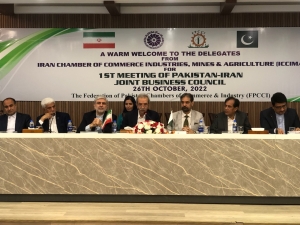
President of Iran Chamber of Commerce, Industries, Mines, and Agriculture (ICCIMA) Gholam Hossein Shafei expressed satisfaction on Wednesday that the free trade agreement between Iran and Pakistan will be finalized soon.
Forming a joint trade council will also be an exceptional opportunity, he said, calling on all those involved in Trade between Iran and Pakistan to become a member of this council.
Noting that the Iranian and Pakistani economies are complementary to each other, he said that Iran is one of the top energy suppliers which can help meet Pakistan’s increasing need for energy.
Shafei also referred to transit sector as one of the main areas for cooperation between Iran and Pakistan, adding that the two countries can launch a high-speed East-West corridor provided that the restrictions on electronic TIR and some other minor issues are removed.
He said that different common grounds, including religious interests and cultural proximity, have paved the way for both countries to make further investments to boost tourism cooperation.
In the meantime, Chairman of Pakistan-Iran trade relations at FPCCI, Najam Jawa, said that banking relations are the most obstacle hindering ties between Tehran and Islamabad.
Noting that there are many grounds for making joint investment, Jawa referred to Iran’s successful experience in investing in Pakistan’s ceramic and tile industry.
He also referred to limited forex resources of both Iran and Pakistan, proposing trade between the two countries to be carried out in national currencies.
Iran should also invest in Pakistan’s food industry, he said, adding that Chinese and Turkish businesspeople are making investments in this area while Iran has done nothing in this regard.
Iran, Pakistan discuss expansion of barter trade

In a meeting between a visiting Iranian private sector delegation to Pakistan and Pakistani central bank officials on Wednesday, the two sides reviewed the implementation of a barter trade mechanism between the two countries.
They also had discussions on resolving differences between Tehran and Islamabad on ways to implement barter trade.
Iran and Pakistan are seeking a barter trade mechanism in a bid to tackle the banking problems on the way of trade between the two neighboring countries.
Zahedan Chamber of Commerce is pursuing the case on behalf of Iran while Quetta Chamber of Commerce and Industry is also representing Pakistan in negotiations about barter trade with Iran.
President of Iran Chamber of Commerce, Industries, Mines, and Agriculture (ICCIMA) Gholam Hossein Shafei, who is heading the Iranian delegation to Pakistan, said that relations between the two countries are exemplary.
He said that despite these close relations, the volume of trade between Iran and Pakistan is “limited and not defendable”.
Barter trade can be a good way for increasing the level of Tehran-Islamabad trade at present, Shafei said, adding that a large number a commodities are in both countries that can be bartered.
The Iran Chamber of Commerce president also stressed the need for an easy passage of the Iranian transit trucks into the Pakistani border as well as accelerating the execution of a free trade agreement between the two countries.
He also said that Iran and Pakistan can use national currencies in bilateral trade to give a boost to exchanges.
Iran, Pakistan private sectors sign three cooperation documents

Chamber of Commerce of Iran and Pakistan have signed three different cooperation documents including among others on forming a joint trade council and resolution of trade disputes.
It comes as a private sector delegation from Iran is on a visit to Pakistan during which the Iranian businesspersons will visit the Pakistani cities of Karachi and Lahore.
The documents were signed by President of Iran Chamber of Commerce, Industries, Mines and Agriculture (ICCIMA) Gholam Hossein Shafei who heads the Iranian delegation to Pakistan and President of the Federation of Pakistan Chambers of Commerce and Industries (FPCCI) Irfan Iqbal Sheikh.
The two sides agreed to establish a joint trade council between the two countries and to devise a mechanism for the resolution of trade disputes.
The agreed upon joint trade council is expected to work alongside Iran-Pakistan Joint Chamber of Commerce to help promote economic relations between the two neighboring countries.
Speaking during an earlier meeting with his Pakistani counterpart, the Iran Chamber of Commerce president said that the two countries plan to increase bilateral trade to $5 billion.
Forming a joint trade council will also be an exceptional opportunity, he said, calling on all those involved in Trade between Iran and Pakistan to become a member of this council.
Iran private sector eyes increased transit cooperation with Pakistan
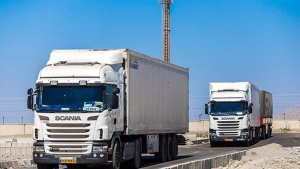
Iranian private sector is seeking to further facilitate transit cooperation with neighboring Pakistan.
Behnam Faramarzian, the director of international transportation and TIR carnet department of Iran Chamber of Commerce, Industries, Mines and Agriculture (ICCIMA), on Sunday underlined the need for border activities with Pakistan, and the urgency for customs services to be provided 24/7 to help further activate border terminals between the two countries.
Faramarzian’s comments comes on the eve of a visit to Pakistan by an Iranian private sector delegation which is due to be headed by ICCIMA President Gholam Hossein Shafei.
Exploring ways to promote transit cooperation will be one of the main agendas of the visit to Pakistan by the Iranian delegation.
Faramarzian, who will be one of the members of the Iranian delegation to Pakistan, said that during his stay in the country, he will pursue expansion of terminals on the joint border, designing a green customs corridor and easing visa issuance process for truck drivers commuting across the joint border.
He believed that resolving transit problems will leave a direct impact on the level of trade exchanges between Iran and Pakistan.
Faramarzian also said that holding talks with the Pakistani operator of Islamabad-Tehran-Istanbul (ITI) Corridor is another agenda of the visit to Pakistan by the Iranian delegation.
During their five-day stay in Pakistan, the Iranian delegation will visit the cities of Karachi and Lahore.
Apart from private sector activists, representatives from the Iranian government will also attend the delegation.
The delegation will be comprised of businesspersons active in different areas including, food and agriculture, oil and gas, electricity and water, petrochemicals, constructional and mining products, pharmaceutical equipment and cosmetics, knowledge-based technology and transportation.